New Transit Storage and Maintenance Facility
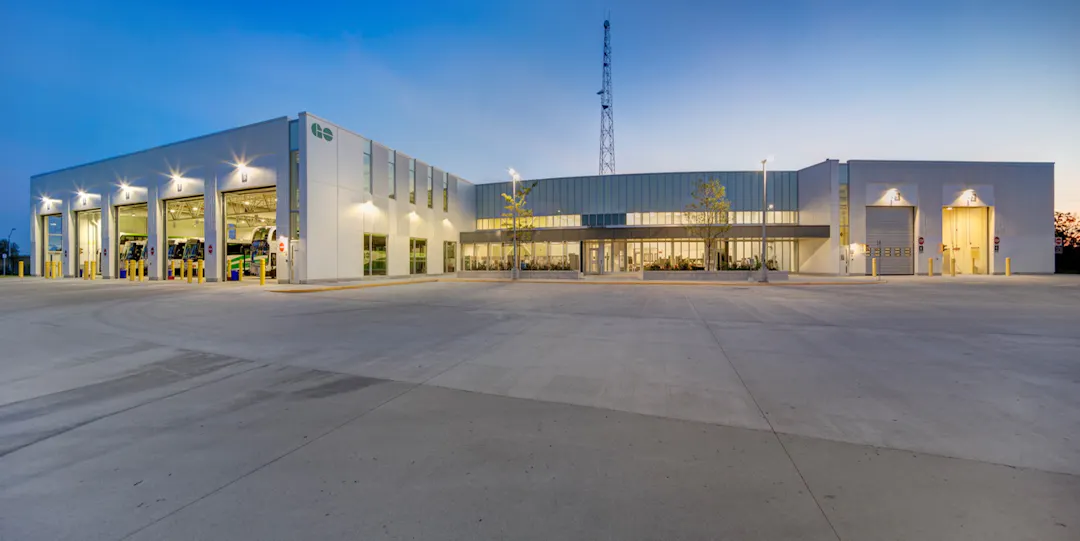
The Project
The City of Peterborough has retained Dillon Consulting Limited to complete the Transit and Rail Project Assessment Process (TRPAP) for a new transit storage and maintenance facility at 910 Monaghan Road and 575 Romain Street.
The new transit storage and maintenance facility will be designed to accommodate an ultimate fleet of 90 to 110 buses and integrated administrative offices.
Over the coming months, the Project Team will be completing technical studies, a preliminary concept design and early engagement activities.
A Community Open House is planned for Fall 2026 to provide an update on the study and gather input and feedback. Following the Community Open House, the Project Team will initiate the TRPAP, which is the formal environmental assessment process, including further engagement.
Why this Project is Needed
The City of Peterborough is planning a new transit garage to support the continued growth and modernization of public transit services. The existing facility is ageing and space-constrained and no longer meets operational and maintenance needs.
Funding for the Peterborough New Transit Garage is provided through the Investing in Canada Infrastructure Program’s Public Transit Infrastructure Stream, with contributions from the Government of Canada, the Province of Ontario, and the City of Peterborough
Site Selection
As outlined in Council Report IPSTR22-014 (July 18, 2022), the City’s consultant evaluated potential sites based on transit operations, size, access, environmental considerations, cost, and compatibility. Details of the site evaluations and rankings are available here. Council approved the preferred site at 910 Monaghan Rd / 575 Romaine Street but also shared reservations regarding transit access from Romaine Street; this will be addressed in future planning.
An early concept plan concept plan for each of the potential sites, prepared solely to demonstrate the site was of sufficient size, showed what appeared to be primary entrance for Transit vehicles on Romaine Street. The City has heard significant concerns from the neighborhood regarding this entrance. The concept plan previously shown has no “status” and was not a site plan. Staff and Councilors are of the opinion the primary transit vehicle entrance would be better suited to a Monaghan Road location. Any transit vehicle entrance to Romaine Street should only be used in an emergency and should be carefully located to minimize disruption to residential property.
Environmental Remediation
The City commenced a due-diligence study of this site in 2024 pursuant to the terms of a purchase and sale agreement with the Canadian Canoe Museum. Much historical information helped inform the diligence scope and strategies.
A site assessment and related remediation project commenced by Dillion Consulting in the late 1990s and early 2000’s supported by funding from the Outboard Marine “receiver” and approved by the then Ministry of Environment, advanced Solvent as well as PCB removals on site. This early remediation work was completed to the extent the available funding allowed but was not finished in terms of addressing full impacts. Hydro-carbon, PCB and Solvent contamination remained in certain areas.
A significant amount of building construction, servicing and physical layout drawings and files allowed our diligence team to track phases and timing of development and building changes, the multiple locations of industrial activities likely to produce contamination and reference points to precisely locate those areas.
A focused regime of testing i.e. boreholes, monitoring wells and sampling produced an accurate picture of the contamination remaining on the site. This work was carried out by Cambium Environmental Consultants, who then brought in an environmental remediation contractor (VEI Ltd) to develop a plan of remediation options, schedules and costs. A remediation program was designed that was estimated at approximately $6,500,000.
In consideration of the above, the City purchased the property from the Canadian Canoe Museum in May 2025. Because the Ministry of Environment, Conservation and Parks (MECP), has authority over all remediation activities, the City and its consultants worked with the MECP to design and confirm a contaminant management strategy for the site. Design of the strategy to remediate the property was completed once the purchase of the property was complete. This strategy would govern the City’s long-term use of the property and would be designed to protect the workers on the site and the neighborhood and downstream properties from further contamination.
Remediation included installation of a permeable reactive barrier, injection of contaminant-neutralizing compounds, removal of source contaminants, and implementation of a monitoring program.
A permeable reactive barrier (or PRB) is a slurry injected directly into the ground. The PRB allows groundwater to flow through it, but components within the PRB neutralize and trap the contaminants before they can be carried off site. The installed PRB at the garage site measures roughly 15-feet wide and 14-18 feet deep and covers the entire southern boundary of the site.
Before the PRBs could be installed, it was necessary to remove a portion of the existing warehouse that was unsafe to enter or work around. A demolition permit was obtained, and the work was completed in accordance with regulatory requirements, which included specific protections for air and water quality. The demolition was overseen by an independent engineering firm. Dust suppression was performed throughout this work.
In locations where high levels of contaminants were identified, there have been two approaches taken to reduce the contaminants. In deep locations, injections of neutralizing agents were completed and additional PRB treatments were installed to encapsulate the contaminants. In other locations that could be reached, materials were excavated and disposed at licensed facilities. This included removal of concrete infused with PCB waste. Similar to demolition, during all excavation work, dust control measures were used.
PCB remediation, achieved by excavation of affected soils and removal of affected concrete, saw all contaminated excavations replaced by clean fill. A separator tank and an interceptor related to solvents were also removed. Almost all of this work took place in the southern portion of the property.
As the groundwater flow is northwest to southeast, there is no anticipated effect to any properties north of the site. Further, the effectiveness of the PRBs along the south of the property is anticipated to allow for the removal of the historic pump and treat system south of this property after more than 20 years.
With the remediation work having been completed the week of June 1, the project will now shift to a monitoring phase. The City’s environmental consultant has installed groundwater monitoring wells in locations identified in consultation with the MECP. Frequent monitoring will be completed over the next two years to confirm the remediation works have been successful. The City expects it will need to establish a long-term monitoring plan with the MECP.
In short, remediation work started more than 20 years ago under previous MECP approval and left short due to financial issues have been completed by the City, again with approval from MECP. The current work was more technically advanced, more efficient and performed in a safe and compliant manner. As of now, the remediation work is complete, and the re-development of the site may commence.
What's next for the project
Transit and Rail Project Assessment Process
The City will soon begin the Transit and Rail Project Assessment Process (TRPAP), a provincially regulated planning and environmental review process for transit projects in Ontario.
What is a TRPAP?
The TRPAP is a streamlined environmental assessment process that:
- Identifies potential environmental impacts (natural, social, cultural, and economic)
- Develops measures to avoid, minimize, or mitigate those impacts
- Includes consultation with adjacent residents, the public, Indigenous communities, agencies, and other stakeholders
- Results in a documented plan for the project, including commitments for future work such as mitigation, monitoring, and further studies
The City will initiate TRPAP to assess environmental impacts and identify mitigation measures associated with the development of the transit garage. TRPAP is a time-limited approach that is required to be completed within 120 days of the Notice of Commencement being issued.
The TRPAP will consider a range of factors, including:
- Traffic and access (including site entrances)
- Noise and emission
- Natural environment impacts
- Stormwater management and drainage
- Urban design and compatibility with surrounding neighbourhoods
- Cultural and archaeological conservations
In reference to the concern regarding access to the future garage, the consultant completing the TRPAP has been provided with direction that the primary transit vehicle entrance should be from Monaghan Road.
Public Engagement during the TRPAP
A key component of the TRPAP is consultation with the public, agencies and Indigenous Peoples. Because of the time limits with the TRPAP, our consultant will complete initial consultation via a TRPAP pre-planning phase prior to the formal Notice of Commencement.
The initial consultation is expected to begin in Summer 2026 to gather community input and concerns. Consultation will be ongoing throughout the pre-TRPAP phase and will continue during the TRPAP, which is planned to begin in late 2026 or early 2027.
Site Plan Approval
Following TRPAP, the project will proceed to the Site Plan Approval process, as a precursor for the detailed design of the facility. The site plan approval will follow the normal process for any private developer which will include site layout, entrances, building treatment, servicing and stormwater management.
The public will continue to have opportunities to stay informed and comment on the project through the Site Plan and detailed design process.
Project Timeline
- Pre-TRPAP / Early Consultation: Summer 2026 to Winter 2026/2027
- Notice of Commencement: Late 2026 / Early 2027
- TRPAP Consultation: Winter 2026/2027 to Summer 2027
- Site Plan: 2027
- Construction Start: 2028
How to Get Involved
Consultation with the public, Indigenous communities, and agencies is an important part of the planning process and we want to hear from you.
You can learn more and stay involved by:
- Requesting to be added to the Project Contact List. Use the form below to provide your email address.
- Attending Community Open House #1 in the fall of 2026. Closer to the date of the Community Open House, invitations will be sent to the Project Contact List and mailed to nearby property owners with information on the date and venue for the Community Open House.
This project is funded in part by the Government of Ontario. Learn more here.
 This project is funded in part by the Government of Canada. Learn more here.
Submit a Comment or Question to the Project Team
Use this form to submit a comment or question directly to the Project Team. If you wish to subscribe to the project, please see the subscribe feature on the right-hand side of the page.